Showing posts with label Kaori Yuki. Show all posts

Friday, April 25, 2008

Ludwit the Third

... volume of the manga, at least. But first a few basics. I’ve already written about “Ludwig Revolution”, a manga (read: Japanese comic) by one of my favourite artists, Kaori Yuki. (As her other series, the last being the three-parter “Fairy Cube”, are all finished, I hope for a few more volumes about Prince Ludwig [or Lui].)


Here’s the short description: Ludwig was sent on a trip by his father (with whom he doesn’t get along well) to find a suitable bride, preferably the princess of another kingdom. While the prince is quite attractive, his character isn’t as perfect as his looks. He has quite a sadistic streak and also a slight fixation on big-breasted women. Travelling with Ludwig are his servant Wilhelm and - starting with volume 2 - also the quite attractive (and rather big-breasted) witch Dorothea (who has quite a masochistic streak, so she would actually be a perfect match for the prince, including the magical knowledge and prowess in poisons she has).

With the second volume (published quite a while after the first, but then, there was a long break in her series “God Child” as well - and it didn’t hurt that series), the story takes another turn, as two more characters (the new wife [and former lover] of Ludwig’s father and her son [who’s also the king’s illegitimate son]) enter the stage and a plot to overthrow and disinherit the prince is put in motion. Assassins (first Wilhelm’s childhood sweetheart Lisseth [known as “Red Riding Hood”], then two former acquaintances of the prince, Hansel and Gretel) enter the story, but none of them can kill the prince, Lisseth even accepts his job offer. As the names - or titles - of the assassins suggest, the base for all stories of the manga are the Grimm fairytales. Starting off with Snow White (Blanche [Neige] who turns out to be a scheming, little bitch far from being innocent), the artist works her way through most known stories (Cinderella filling 90 percent of the third volume) and twists them in a way that makes them less suitable for children, but more interesting for older teens or adults. Ludwig stumbles into most stories by pure accident (mostly because the female lead is supposed to be very beautiful and, yes, big-breasted) and does his best to get out of them again - not above helping others, but not really looking for chances to be that white knight, either.


Volume 3 deals mostly with the story of Cinderella (who, in this version, rather enjoys being treated badly by her step-sisters ... thinking it better than to be completely ignored), but it starts off with the sombre story of Hansel and Gretel, being sent into the forest by their parents, getting caught not by a witch, but by a murderess, turning the tables on her (with a flame-thrower) and becoming assassins. While they nominally work for Julius (who, as the third volume tells the readers, actually is Ludwig’s half-brother), they remember the prince as a good person and in the end can’t kill him.

The plot really thickens, as the prince is returning home - which will force his father to do something. The interesting question is how much power the king has. Is it absolute and he can just kick out his son? Or does he have to listen to other people and can’t just disinherit the prince at will? The fact alone that Julius tries to have his older half-brother killed, suggests he can’t just be promoted ahead. And the fact that Ludwig hasn’t been kicked out before (as he and his father really don’t get along), suggests the same thing.


If you’re into manga, you might find you like this story (provided you can live with the twisted images of your favourite fairytales). It’s dark, full of blood, but at the same time also shows quite some humorous parts.

Monday, December 17, 2007

Grim Grimms

The fact that the second volume of "Ludwig Revolution" is out (finally!) has once more made me realize how grim the traditional fairy tales are.


The Grimm brothers (well, the oldest two of four, actually) were not gathering the fairy tales and legends for children. At that time, a lot of adults were interested in traditional German folklore and read such stories. Gathering the fairy tales wasn't as strenuous as it's often pictured these days, either. Mostly the brothers - who were working as librarians - got the stories by letter. Friends and acquaintances would gather the stories in their local area and write them down, then they would sent a copy of those stories to the brothers who, in turn, would put it in their collection. Later on their younger brother Ludwig (after whom, as I learned from the epilogue of volume two, the prince in the manga is named) would draw some pictures to go with the text.


Today a certain number of those tales - like Snow White, Little Red Riding Hood or Sleeping Beauty - are very well known, although rarely in their original form. To make them more suitable for children, quite a lot of the gruesome details (like the end of the evil stepmother in Snow White who is forced to dance in red-hot iron shoes until she dies) were simply cut out. As were some other details (like Rapunzel being pregnant...). The 'true' fairy tales of the Grimm Brothers actually go quite well with the movie "Brothers Grimm" which came out a couple of years ago. (I actually like it.)


  • Snow White is almost killed various times: by the hunter first, then by her own stepmother.
  • Sleeping Beauty herself is cursed to die on her 16th birthday, only the involvement of the last good fairy prevents that, turning death into a deep sleep. The princes trying to get through the thorn bushes fare less well: they die slowly in there.
  • Little Red Riding Hood and her grandmother are eaten alive and, today a definite no-go, the wolf is cut open while still alive, too.


The list goes on and on and on, believe me - I was lucky as an older child and could read the very good reprints of the original stories. But during the time the fairy tales were told this way, the idea of strict punishment for the sins the evil characters had committed was quite normal.


Even when watching the sweet and children-friendly Disney version of various fairy tales, one should never forget that they are old stories and all old stories are - as Terry Pratchett once wrote - sooner or later about blood.

Wednesday, September 26, 2007

More Kaori Yuki

As I have stated more than once, I'm not only a manga-fan, but also a fan of Kaori Yuki's work. Currently luck seems to be on my side, as far as this is concerned.

Two of her manga are going to be published this year, "Perfume Master" has been published now, the second volume of "Ludwig Revolution" will be published in December.


"Perfume Master" is the story of a young man with exceptional talents. His sense of smell is keen enough to even smell out a certain type of rose perfume on a person wearing a large bouquet of roses. And this is was usually gets him into trouble. And it's his cousin who gets him out of it again - the girl does not only look like a model (she's from France, her father married an aunt of the perfume master and brought her into the marriage), but also is a very dangerous fighter. Although, admittedly, sometimes it's his cousin who gets both of them into trouble.

As usually, the story of "Perfume Master" (or rather the three stories) is a very dark one. The secrets the young man finds out about usually have to do with murder, death and revenge. And the characters all have the special look I like so much, the rather unusual look only Kaori Yuki draws.


The first volume of "Ludwig Revolution" on the other hand was published quite some time ago, including four different stories based on European fairy tales. They were connected by the main character, Prince Louis (or Ludwig, as both names have the same base) who is looking for a bride. Ludwig/Louis is a rather strange character, looking for girls with big breasts (although in a side note the author admits it's rather more her obsession than his...). He also tends to fall for murderous, endangered or cursed girls, which in turn gets him into trouble as well, very much to the dismay of his servant William who then has to try and get him out of that trouble again. Neither Snow White (who, in this story, really is a scheming little bitch), Little Red Riding Hood (who was William's childhood crush and has turned into an assassin), Sleeping Beauty (who dies upon being awaken after a hundred years - what do you expect, honestly?) or a girl wanted by Bluebeard (who's quite a weakling, and stupid, mistaking the over six feet tall prince for a girl) have proven to be the right bride.


The second volume will feature four more European fairy tales and I'm already really waiting for it - I always thought one volume wasn't enough. And I hope Dorothea, the witch from "Sleeping Beauty" (in the first volume) will be making another appearance. So I'll wait for volume two and hope for more ghastly, bloody and scary stories to feast upon.


And I hope for yet more manga by Kaori Yuki who is just as fascinated by the dark side of the human mind as I am...

Saturday, June 30, 2007

Finally another good Vampire Story

Vampires are among the creatures of the night that are most portrait in novels, comics and movies, but to find a descent vampire manga is quite difficult. This week I managed.


That might have something to do with the fact that there aren't vampires the way we see them in Japan. They have blood-drinking and life-sucking ghosts, but that's not the same. Nevertheless, the Western vampire is quite known in Japan these days. There are some good vampire stories in Manga, Kaori Yuki, forever one of my favourite artists, has done quite a few of them. The first "God Child" story featuring Jezebel Disraeli and Delilah, "Kafka", has a strong vampire motif, although the vampire is man-made. There's a short story about genetic vampires in the short story collection "Boy's next door". And then there's "Blood Hound". Apart from that I can only name "Model", "Rebirth" and "Hellsing" as stories mainly dealing with vampires (but "Model" and "Rebirth" technically aren't manga, because they come from Korea).

Since this week I can add another series to that list: "Trinity Blood". I'd completely ignored it before, because the few things I'd read about it weren't very interesting and I didn't see any of the manga until volume 5, because I wasn't going through the manga at the shop at the train station for a while and my favourite book-shop didn't have them.


But this week I stumbled over volume 5 - and then ordered the other 4 over amazon. The story is good, the graphics are, too. And, in addition, the whole scenario (set in a future in which the vampires have taken control of most of the world and only the church is still fighting them) is quite interesting. And two of the main characters just make up for a lot of funny situations ... that's what I like in a manga with a lot of fights.


And with "Fairy Cube" and "Detective Loki - Ragnarok" complete (since this month) and "Ludwig Revolutions" volume 2 coming 'sometimes' in the future, I can afford starting a new series...


I just love vampire stories!

Saturday, December 23, 2006

"Fairy Cube" and why I love it

As I've mentioned before, I love the manga by Kaori Yuki, each and every of them.

So you can probably imagine how happy I was when I found her new series, "Fairy Cube", at my favourite bookshop. I bought it on a whim - and because I knew I'd probably like anything written and drawn by her - and wasn't disappointed.


I can't tell too much about the story at the moment - I've just read the first volume of a multi-volume series -, but it's already getting interesting. For one thing the main character has already died and become some kind of wandering spirit, just to come back into another body, just to get his own back.

Then there's the evil spirit which has taken over his body after making his own father stab him. It's a changeling - there's a lot of European and especially Irish/Celtic mythology in it, something I like a lot as well - who has chosen the hero's body when they were both little.

Then there's a strange man who can see fairies and lost souls and can also do magic. He's behind both the hero loosing his body (because of a cube with a lizard in it which he gave the hero, in the story those cubes house the spirits of fairies and other supernatural creatures who want to have their own human body) and getting a new one. His eye-patch reminds me of 'One-eyed Cross', a character from "Neji", another of Kaori Yuki's stories.

Then there's the grandmother of the boy in whose body the hero returns to the world of the living - after the boy died because the fairy trying to take over his body could not control it. She's blind, but she can see more than one might expect - as the last scene of the first volume shows.

Then there's the girl he loves and who has - in her youth - also believed in fairies. She's in danger because of the changeling in the hero's body who wants her - because he knows the hero watches over her and loves her.

Then there's the hero's father who has to live with almost - as the body is not dead - killing his own son ... and suddenly being treated completely different by him.

Then there's a little fairy living with the magician with the eye-patch. She wants a human body, too, but she also wants to help the hero after seeing how completely he's focused on his goals.

Finally there seems to be a third party in the magical department, a seemingly young boy who turns up a the site of the burned down shop of the magician and will surely - if I know anything about the way Ms. Yuki writes - play an interesting role in the future.


As always there's beautifully drawn people and other creatures (like the translucent fairies you can see in some panels whenever the hero calls up the other world) and loads of blood. As always there's Kaori Yuki's style with a lot of grey and shadows. There's the horror coming right after a comedic break. It's a very promising first volume and I'm sure I won't regret buying and reading the series.

Wednesday, November 29, 2006

The dark world of Kaori Yuki

I like dark stories and unlike some other people, especially in Germany, I'm not ashamed about it at all. I am 32 and still read Manga and I'm not afraid to admit that either. As a result of my tastes, one of my favourite Manga artists is Kaori Yuki.

She has a very special style with a lot more grey than most other artists I know. Manga tend to be black/white mostly, as they are printed without any colours. The only thing an artist can use to create different shades in a picture is grey. Mostly this is done with special foil that brings structures (from a simple dot pattern right up to complete shapes like hearts done in dots) into the picture. Kaori Yuki uses those, of course, most Manga artists do. She even uses more of them than most other artists. What fascinates me about her pictures is the intensity the reaches through those fairly simple means. She gives her pictures a surprising depth for a simple Manga (which in Japan is considered something to read and throw away, we're not talking about lasting art here).


I first came in contact with her style when "Angel Sanctuary" was published in Germany. It's up to the present her longest running series, complete in 20 volumes of softcover pocketbooks. The background of the story is a dark one, telling of the disappearance of god and the effects this had on Heaven and subsequently on Earth as well. I will not go around retelling the whole story here, but it's complicated and sometimes full of surprises.


Short stories, gathered in the two paperbacks "Boys next door" and "Neji - Screw" followed soon afterwards. "Boys next door" contains stories about gruesome happenings in more or less everyday life, while all three stories of "Neji - Screw" are centred around a young boy who is deadly wounded and awakes in a future in which he's supposed to just be a little piece (like a screw) in the machinery, something against which he rebels.


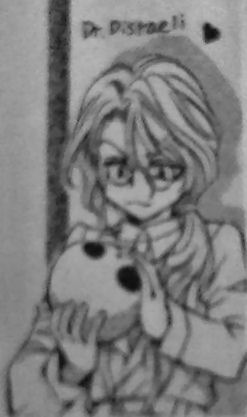
Then her second longer series was published as well: "God Child", one of my all time favourites. "God Child" is set in a Victorian environment and deals with madness, murder and the occult - all things I'm really interested in. Besides, for a drawn character both the hero of the tale, Cain C. Hargreaves, and one of his adversaries, Dr. Jezebel Disraeli, are quite cute (check the end of this post for a little picture of Dr. Disraeli's cute SD-form).


Recently four more one-volume paperbacks have been published in German, namely "Ludwig Revolutions", "Bloodhound", "Gravel Kingdom" and "Cruel Fairytales". "Ludwig Revolutions" retells four European fairytales (Snow White, Little Red Riding Hood, Sleeping Beauty and Bluebeard) with certain changes, making them all revolve around a prince named Ludwig searching for a bride. "Bloodhound" is a vampire story in which the vampires actually are the good guys - mostly. It's more funny than it sounds. Both "Gravel Kingdom" and "Cruel Fairytales" are collections of short stories with similar background ("Gravel Kingdom" mostly deals with fantasy environments, while "Cruel Fairytales" is based on crime stories).


What I like most about Kaori Yuki's stories, however, is the way she manages to combine horror, death, blood and crimes with humour. This makes for an interesting reading and, as is always the case in such combinations, even intensifies the dark aspects of the story.


© 2000 Kaori Yuki